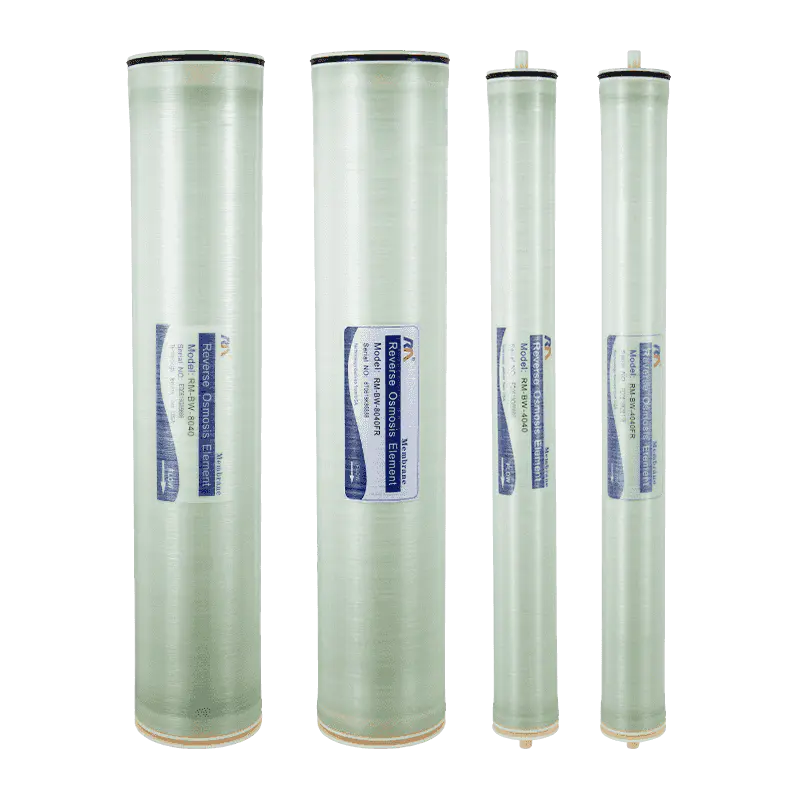
Brackish water sits between freshwater and seawater in terms of salinity, but its treatment requirements should not be treated as a simple midpoint between the two. Groundwater, surface water, municipal sources, and saline wastewater can all have different compositions. For reverse osmosis projects, membrane selection therefore depends on feed-water quality, pressure requirements, target water quality, and the intended application.
What Makes Brackish Water Different?
Brackish water contains more dissolved salts than typical freshwater but generally less than seawater. Its exact composition varies according to geographical conditions and the source of the water. Groundwater affected by mineral deposits, for example, can have a very different balance of salts and other substances from surface water influenced by agricultural or industrial activity.
This variation matters because reverse osmosis membranes are selected according to specific operating conditions. A membrane designed for highly saline seawater is not automatically the most economical choice for lower-salinity feed water. Conversely, a membrane intended for relatively low-TDS sources may not be suitable when salinity rises significantly.
Why Brackish Water RO Uses Different Membrane Designs
RO works by applying pressure to push water through a semipermeable membrane while retaining many dissolved salts and other contaminants. The required pressure is influenced by feed-water salinity and the system’s target recovery and permeate quality.
A brackish water reverse osmosis membrane is designed specifically for this type of feed-water environment. Runmo’s BW Series uses aromatic polyamide composite membrane elements and is intended for brackish-water desalination. According to the manufacturer’s product information, the series combines high water production with good desalination performance and can remove soluble salts, TOC, and SiO₂.
The BW Series is described as suitable for desalination of surface water, groundwater, tap water, and municipal water with salt content below 10,000 ppm, while its published operating limit specifies a maximum feed-water TDS of 5,000 ppm. The products are also positioned for industrial pure-water production, boiler feed water, high-concentration saline wastewater treatment, and beverage-water manufacturing.
Brackish Water Membranes vs. Seawater Membranes
The biggest difference is the feed-water condition for which each membrane family is intended. The BW Series is designed for brackish-water applications, while the SW Series is specifically developed for seawater and high-concentration brackish water.
The published BW specifications list a maximum feed-water TDS of 5,000 ppm for its BW Series under the stated operating limits, while the maximum working pressure is 600 psi. The specified continuous operating pH range is 2–12, with a maximum feed-water temperature of 45°C.
By comparison, selecting a seawater membrane for a lower-salinity application may add unnecessary pressure or system requirements. The practical choice is therefore not about identifying which membrane is “stronger,” but about matching the membrane to the actual feed-water conditions.
Where Brackish Water RO Is Commonly Used
Brackish water RO can support several industrial and municipal water-treatment applications. Groundwater desalination is one example, especially in regions where naturally occurring dissolved salts make the source unsuitable for the intended use. Surface water and municipal water can also be treated when dissolved solids need to be reduced.
Industrial applications can have more specific objectives. The manufacturer lists pure-water preparation, boiler recharge water, food processing, and pharmaceutical manufacturing among the main application areas for its BW Series. The product page also identifies high-concentration saline wastewater and beverage-water manufacturing as relevant brackish-water applications.
For engineering companies and water-treatment solution providers, this flexibility can make BW membranes useful across projects with different scales and water sources. The correct system configuration still depends on the analysis of the source water and the required final quality.
BW Series: Product Details to Compare
The BW Series includes several membrane element options. The published lineup contains RM-BW-4021, RM-BW-4040, RM-BW-8040, RM-BW-4040FR, and RM-BW-8040FR. Their membrane areas range from 3.3 m² to 37 m², with average permeate production from 3.6 m³/day to 39.5 m³/day under the manufacturer’s stated testing conditions.
For example, the RM-BW-4040 has a membrane area of 7.9 m² and an average permeate production of 7.6 m³/day, while the RM-BW-8040 provides 37 m² of membrane area and an average permeate production of 39.5 m³/day. Both models list stable rejection of 99.5% under the specified test conditions.
Runmo also offers FR versions. The product information explains that a special surface treatment changes the membrane surface’s electric charge and smoothness, increases hydrophilicity, and is intended to reduce the attachment of pollutants and microorganisms to the membrane surface. The RM-BW-4040FR and RM-BW-8040FR list stable rejection of 99.6% under the manufacturer’s test conditions.
These figures are useful for initial comparisons, but field performance can differ because feed-water composition, pressure, temperature, recovery, pretreatment, and system configuration all affect actual results.
Pretreatment Still Matters
Even a well-matched membrane needs suitable feed-water preparation. Runmo’s BW specifications place limits on turbidity, SDI, hardness, COD, BOD, TOC, and residual chlorine. The stated maximum turbidity is 1 NTU, while the maximum feed-water SDI15 is 5.
This is why membrane selection should be part of a complete treatment strategy. Pretreatment can reduce the amount of suspended material and other substances reaching the RO stage, helping maintain more stable operating conditions. Regular monitoring is also useful for identifying changes in feed-water quality before they affect membrane performance.
What Should Buyers Evaluate?
Before purchasing a brackish water reverse osmosis membrane, buyers should first obtain a reliable feed-water analysis. TDS is important, but it should be considered alongside temperature, hardness, turbidity, SDI, organic content, pH, and other relevant parameters.
System capacity is another key issue. Membrane area and expected flow need to correspond with the required production volume, while pressure limits must fit the available equipment. Procurement teams should also compare price, quality, delivery time, customization options, and technical support. These factors can be particularly important for smaller water-treatment companies and engineering contractors handling multiple projects.
Matching the Membrane to the Water Source
Brackish water RO occupies an important position between lower-salinity treatment and seawater desalination. Selecting a membrane according to the feed-water conditions can help align the system configuration with the required salt reduction and operating pressure.
For water-treatment projects dealing with brackish sources, membrane selection comes down to the relationship between feed-water quality, system capacity, and treatment targets. Runmo supports these requirements with BW membrane options in different configurations, alongside solutions for seawater, ultrafiltration, nanofiltration, and lower-pressure applications. Reviewing the actual water analysis, required output, and operating conditions first gives buyers a clearer basis for choosing the right membrane for the system.