Daily sheet-metal work rarely follows a single production pattern. One order may require electrical cabinet panels, another may involve machine guards, and a third may call for brackets with closely spaced holes and precise edges. The practical value of a 6 kW fiber laser cutting machine depends on how well it handles this mix of materials, geometries, and batch sizes. Hymson Laser Machinery operates in the industrial laser equipment sector, where equipment suitability is best judged by the demands of routine production rather than specifications in isolation.
Common Applications Across Sheet Metal Workshops
Electrical enclosures and control cabinets are common applications for laser-cut sheet metal. Their panels often require mounting holes, ventilation slots, cable openings, and accurately positioned edges that align during assembly. Consistent cutting helps reduce fitting adjustments later in the process, especially when multiple panels must match. Production trials should examine both dimensional accuracy and the condition of edges that will be bent, coated, or assembled.
Machinery manufacturers also rely on cut plates, brackets, covers, and protective guards. These components vary in size and geometry, so performance depends on more than the ability to cut straight lines quickly. Small holes, narrow slots, and detailed contours may require slower movement or different process settings. Evaluating a representative selection of parts gives manufacturers a clearer picture of how the equipment performs across an actual order mix.
Custom fabrication introduces another challenge: frequent job changes. Workshops handling short runs may switch between drawings, materials, and thicknesses several times per shift. Programming efficiency, material identification, and setup procedures can influence productivity as much as cutting speed. A 6 kW laser cutting machine should be assessed under these changing conditions if flexible, day-to-day production is a major requirement.
Match Material and Thickness to the Job Mix
Material selection shapes both cutting behavior and finished-part quality. Carbon steel, stainless steel, and aluminum have different processing characteristics, while surface condition and thickness can influence the suitable cutting parameters. A workshop should review its regular material grades and identify which combinations account for most orders. This helps establish whether the proposed equipment matches current requirements without relying solely on its maximum stated capacity.
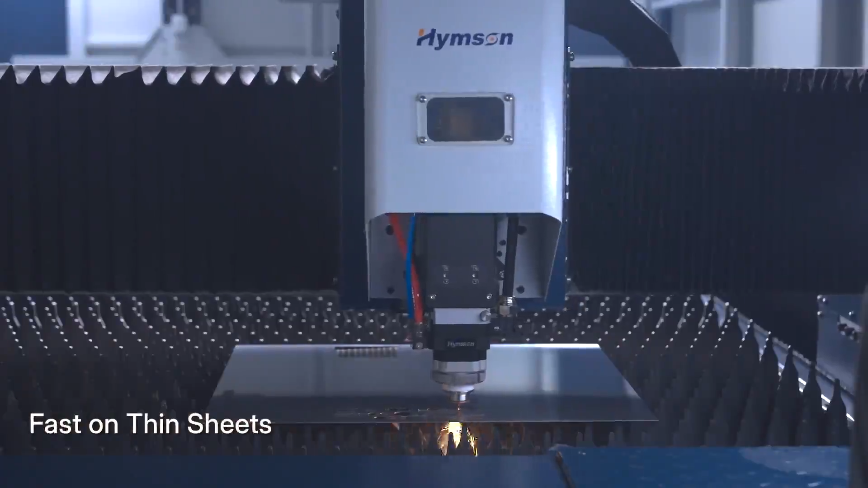
Thickness distribution deserves particular attention. Thin sheets may be processed rapidly, but intricate contours and dense hole patterns can limit the benefit of higher cutting speeds. Thicker sections may require more careful control of assist gas, focal position, and cutting conditions to achieve the desired edge finish. Test pieces should reflect the workshop’s real material range, including jobs that are difficult to process consistently.
Material utilization also affects the economics of routine fabrication. Nesting software can arrange components to reduce unused sheet area, although part orientation, grain direction, and downstream bending requirements may restrict layout choices. Scrap should be tracked alongside cutting time when different configurations are compared. For a 6 kW laser cutting machine, practical performance includes the ability to produce usable parts efficiently, not simply the speed of the cutting head.
Evaluate Setup Efficiency and Production Flexibility
Production schedules often lose time between jobs rather than during the cutting cycle itself. Operators may need to select programs, confirm material specifications, position sheets, remove finished parts, and prepare the next order. Recording these activities during a trial reveals whether delays come from the machine, the workflow, or the surrounding handling process. Improvements in setup discipline can sometimes deliver significant gains without changing the laser configuration.
Software and operator interaction deserve close examination as well. Clear program management, accessible parameter settings, and straightforward error messages can reduce avoidable interruptions, particularly for teams handling many part numbers. Training should cover routine operation, safe material handling, basic troubleshooting, and preventive maintenance. These factors influence how consistently the workshop can use the machine across different shifts and operators.
Validate Performance Through a Production Trial
A useful production trial begins with representative parts rather than a specially selected demonstration sample. Manufacturers can prepare drawings for routine components, complex contours, and materials that have historically caused quality issues. Before testing, the parties should agree on dimensional tolerances, acceptable edge condition, and how cycle time will be measured. Consistent criteria make comparisons more meaningful and reduce the risk of judging performance by appearance alone.
During the trial, the workshop should record cutting time, setup duration, rejected parts, material waste, and any need for secondary finishing. Several parts should be inspected to check repeatability, rather than relying on a single successful result. If a component requires deburring or dimensional correction after cutting, those tasks should be included when calculating the real production time. The resulting data can be compared with current methods using the same quality standards.
The HyLaser PLUS is designed around cutting quality, production reliability, safety protection, and user-friendly operation for everyday manufacturing. Its suitability should be assessed through the same practical checks used for any candidate system, including job-change efficiency, consistency across representative parts, and compatibility with the workshop’s material-handling arrangements. Testing a 6 kW fiber laser cutting machine under realistic batch conditions provides a stronger basis for investment than relying on a short demonstration or an advertised speed figure.
Conclusion
Everyday sheet-metal fabrication rewards equipment that can handle the workshop’s actual parts, maintain repeatable quality, and adapt to changes in order volume. Application fit, material behavior, setup time, operator capability, and maintenance requirements should all inform the final decision. Hymson Laser Machinery can be evaluated through documented trial results and the relationship between machine capabilities and production needs. The right 6 kW laser cutting machine is not simply the one with an appealing specification; its value lies in producing acceptable components efficiently across the jobs that matter most to the business.