Selecting industrial mixers for a chemical processing plant requires more than comparing motor power or purchase prices. Equipment performance depends on fluid properties, impeller geometry, vessel dimensions, installation configuration, and the required degree of homogenization. A mismatch between these factors can lead to uneven batches, unnecessary energy consumption, and extended processing times.
Engineers evaluating industrial mixing solutions should therefore compare technical specifications against actual process conditions. A structured assessment helps procurement teams identify suitable equipment, communicate requirements to suppliers, and evaluate total operating costs before committing to a purchase.
Viscosity Range and Material Properties
Viscosity is one of the first parameters engineers should establish. Low-viscosity liquids generally circulate more readily, while viscous fluids can require greater torque and carefully selected impeller geometries to achieve effective bulk movement.
The comparison should include minimum and maximum operating viscosity, density, temperature, and whether the material behaves as a Newtonian or non-Newtonian fluid. Engineers should also identify solids content, particle characteristics, and whether the process involves immiscible liquids or gas-liquid contact.
These properties influence the appropriate chemical mixing systems. Conventional agitation may be suitable for bulk blending, whereas dispersion, emulsification, or intensive homogenization can require different equipment configurations. Suppliers should evaluate the complete material profile rather than recommend a machine based on viscosity alone.
Motor Power, Speed, and Torque
Motor power alone is not a reliable measure the performance of chemical mixing systems. Engineers should compare rated power, operating speed, available torque, and the impeller’s ability to maintain circulation under actual process loads.
Rotational speed affects flow patterns and shear, while torque determines the turning force available to overcome resistance. High-viscosity materials may require substantial torque even at relatively low speeds. Conversely, faster rotation does not automatically produce better bulk blending and can increase energy consumption or introduce unwanted air.
When reviewing industrial mixing solutions, engineers should request operating data for the intended material and batch conditions. Variable-speed control may be valuable when formulations, production stages, or operating temperatures change. Comparing power consumption at the required mixing performance provides a more meaningful basis for selection than comparing motor ratings alone.
Impeller Design and Installation Position
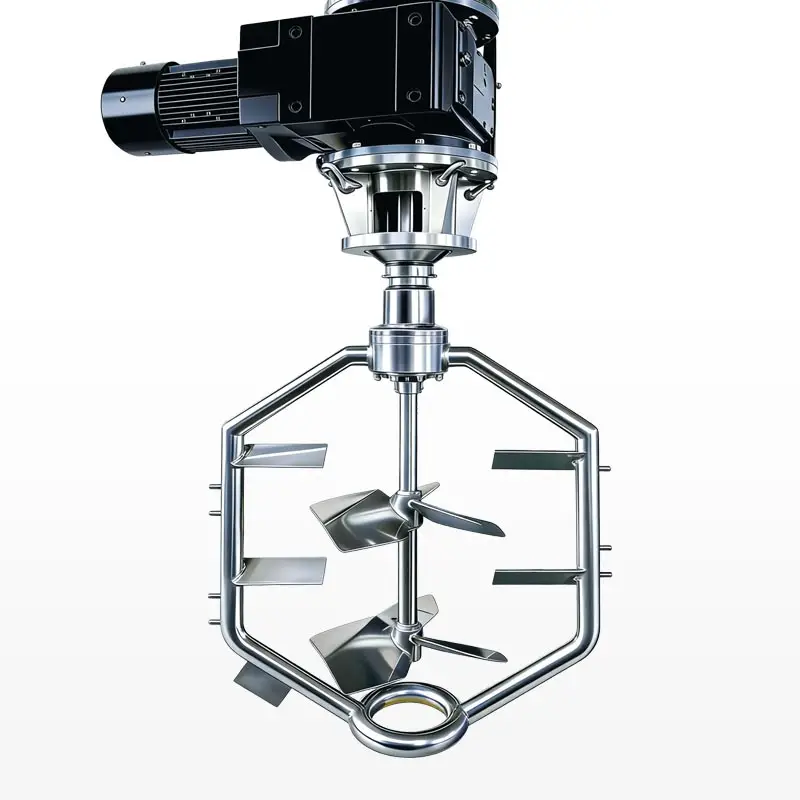
Impeller geometry determines how energy transfers into the fluid. Different blade designs generate different combinations of axial flow, radial flow, circulation, and shear. Selection should reflect the process objective, whether it is blending miscible liquids, suspending solids, or maintaining a uniform composition throughout a vessel.
Installation position also matters. Top-mounted mixers are commonly used where access from above is practical, while side-mounted arrangements can suit certain large tanks or storage applications. Bottom-mounted configurations may be appropriate for specialized vessel designs and process requirements. Each arrangement introduces different considerations for maintenance, sealing, shaft support, and vessel integration.
FLUKO’s EUMIX Series offers top-mounted, side-mounted, and bottom-mounted installation options, with different impeller forms selected according to material properties and process requirements. Its stated purpose is to mix two or more materials with different phases or properties toward overall homogenization. Engineers should confirm the specific impeller and configuration required for each application rather than assume every option suits every material.
Vessel Geometry and Working Capacity
Tank dimensions influence circulation patterns, mixing time, and the distribution of material throughout the vessel. Engineers should compare working volume, tank diameter, liquid height, impeller diameter, and the number and positioning of impellers.
Baffles and other vessel internals may also affect vortex formation and fluid circulation. A mixer designed for one tank geometry may not deliver equivalent performance when installed in a vessel with different proportions.
For chemical mixing systems, suppliers should evaluate the vessel and agitator as an integrated arrangement. Procurement specifications should distinguish nominal tank capacity from actual working volume and identify minimum and maximum batch levels. These details help prevent equipment undersizing and reduce the likelihood of costly modifications after installation.
Wetted Materials, Sealing, and Maintenance
Chemical compatibility is essential when processing corrosive, reactive, or temperature-sensitive substances. Engineers should identify the materials used for shafts, impellers, seals, and other product-contact components, then verify their suitability for the actual chemicals and operating conditions.
Stainless steel is not automatically appropriate for every formulation. Compatibility depends on chemical concentration, temperature, exposure time, and other process variables. Seal selection also deserves attention where leakage, contamination, or emissions could create operational risks.
Maintenance requirements should be compared alongside initial equipment cost. Consider access to wear components, seal replacement procedures, spare-part availability, and the time needed for routine inspection. A supplier should provide sufficient technical documentation to support safe operation and planned maintenance.
Mixing Performance, Energy Use, and Supplier Support
Engineers should establish measurable acceptance criteria before comparing quotations. Depending on the application, these may include mixing time, concentration uniformity, solids suspension, temperature consistency, or final product characteristics.
Where practical, pilot testing can help validate the proposed configuration before full-scale installation. Scale-up should consider more than matching rotational speed: vessel geometry, impeller dimensions, power per unit volume, and fluid behavior can all influence performance.
Supplier support is another important comparison point. FLUKO develops mixing, dispersion, emulsification, and homogenization equipment for industrial applications. Its engineering resources and experience across process-intensification projects may be relevant when evaluating configurations for demanding chemical processes. Buyers should request application-specific recommendations, documented test results where available, and clear commitments covering commissioning and after-sales support.
Build a Specification-Based Equipment Shortlist
The most effective equipment comparison starts with process requirements rather than a preferred machine model. Engineers should document material properties, operating conditions, tank geometry, installation constraints, safety requirements, and measurable performance targets before requesting quotations.
Comparing these parameters side by side helps procurement teams evaluate industrial mixing solutions on technical suitability, energy demand, maintenance needs, and lifecycle cost. The EUMIX Series from FLUKO provides one example of a configurable mechanical mixing range for applications requiring different installation arrangements and impeller designs.
Ultimately, selecting the right mixing equipment company means finding a supplier that can explain its engineering choices and substantiate its recommendations. A detailed specification review creates a stronger basis for reliable production, consistent product quality, and long-term operational value.