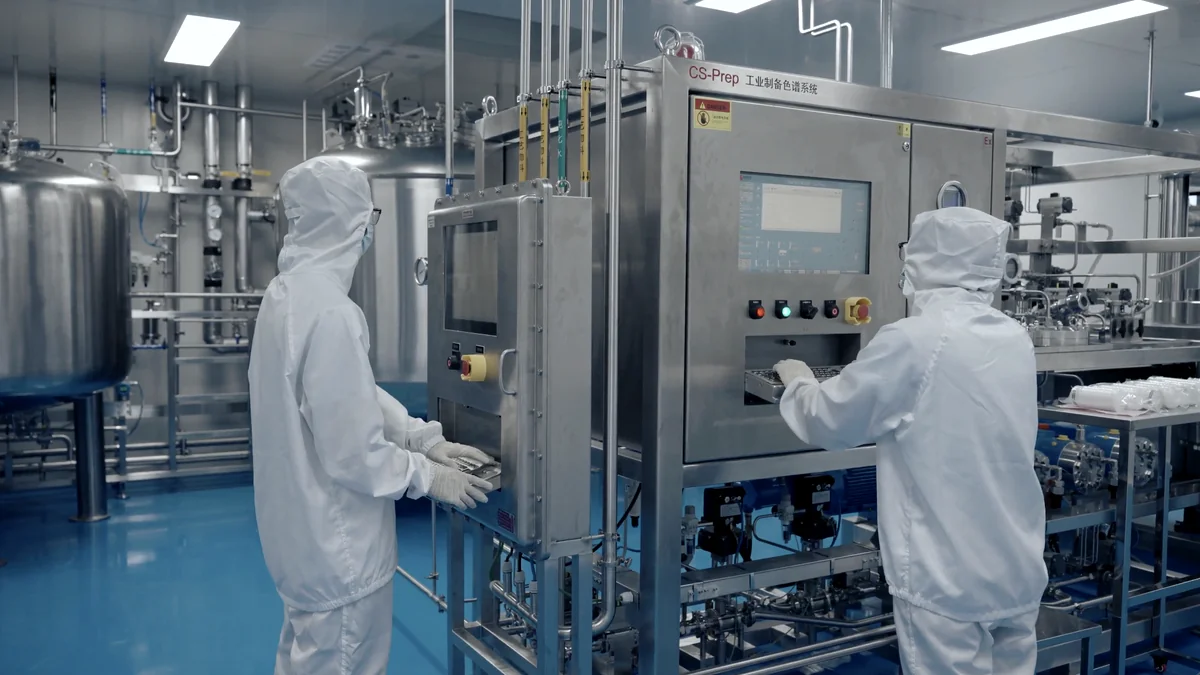
Peptide manufacturers face a persistent challenge: producing complex sequences with consistent quality while controlling material consumption, processing time, and overall production costs. Coupling efficiency is a key factor in this balance. Each amino acid addition must proceed effectively, because incomplete reactions can generate impurities that complicate purification and reduce the amount of usable product. For pharmaceutical companies and biotechnology businesses, understanding this relationship helps guide supplier selection, process development, and manufacturing decisions.
Understanding Coupling Efficiency in Peptide Synthesis
Coupling efficiency describes how effectively an activated amino acid reacts with the growing peptide chain during synthesis. In solid-phase peptide synthesis (SPPS), each coupling step extends the chain attached to a solid support. The reaction must proceed sufficiently to limit incomplete sequences and maintain the intended molecular structure.
A successful coupling step does not guarantee a successful final batch. Peptide synthesis involves repeated coupling and deprotection cycles, followed by cleavage, purification, and other downstream operations. Small inefficiencies can accumulate across a long sequence, making reaction monitoring and process optimization important to overall manufacturing performance.
Why Coupling Efficiency Directly Affects Yield
Incomplete coupling can leave reactive sites unoccupied, producing deletion sequences or other related impurities. Depending on the synthesis process, these impurities may be difficult to separate from the target peptide. Additional purification can reduce the quantity of recovered product, even when the initial synthesis generates a substantial amount of crude material.
The effect becomes more significant as sequence length and complexity increase. Steric hindrance, aggregation, solubility limitations, and the properties of particular amino acids can make some coupling steps more difficult than others. Research on peptide synthesis identifies incomplete reactions and sequence-related challenges as important contributors to lower overall efficiency and increased purification demands.
How Coupling Efficiency Influences Manufacturing Costs
Coupling efficiency affects more than the quantity of product recovered. Poor performance at individual synthesis steps can increase amino acid and coupling reagent consumption, extend production cycles, and create additional analytical and purification work. Repeated coupling may improve conversion, but it also requires more reagents, solvents, equipment time, and process control.
For manufacturers, the objective is not simply to maximize conversion at any cost. Excessive reagent use or aggressive reaction conditions may introduce unwanted side reactions. Cost-effective synthesis requires a balanced approach that achieves the required product quality while limiting unnecessary resource consumption.
Process Optimization: From Reaction Conditions to Purification
Improving coupling performance starts with understanding the sequence and the reaction conditions. Reagent selection, solvent compatibility, temperature, reaction time, amino acid structure, and resin behavior can all influence coupling outcomes. Difficult sequences may require tailored conditions rather than a standard procedure applied uniformly across every residue.
Process monitoring helps identify incomplete reactions before they affect subsequent steps. The Kaiser test can detect residual primary amines in suitable synthesis contexts, but its results do not independently confirm complete coupling and may be unsuitable for certain residues, such as proline. Manufacturers should select appropriate in-process tests for the specific sequence and supplement them with suitable analytical methods when evaluating reaction completion and deciding whether additional coupling or other corrective measures are necessary.
Purification strategy must be considered alongside synthesis efficiency. Better coupling can reduce certain impurities, but it does not eliminate all purification losses. Chromatographic conditions, fraction selection, peptide solubility, and product recovery still influence final yield. Optimizing the entire process therefore provides a more reliable basis for cost reduction than evaluating coupling efficiency in isolation.
Why Coupling Efficiency Matters in Peptide API Manufacturing
For pharmaceutical and biotechnology buyers, peptide API manufacturing requires a consistent balance among yield, purity, reproducibility, and supply economics. A process that performs well in laboratory experiments may behave differently at larger production scales, where mixing, material handling, reaction control, and purification capacity become more demanding.
Manufacturers should evaluate both crude yield and final isolated yield. Crude yield reflects the material obtained before purification, whereas isolated yield accounts for material recovered after relevant downstream operations. Comparing these measures helps reveal whether losses originate mainly during synthesis or during purification and isolation.
The European Medicines Agency’s guideline on synthetic peptide development and manufacture emphasizes process descriptions, critical-step controls, impurity management, and batch traceability. These principles are relevant when assessing whether a manufacturing process can consistently deliver material that meets its agreed specifications.
Evaluating a Manufacturing Partner Beyond Yield
Procurement teams should ask potential suppliers how they monitor coupling reactions, investigate difficult sequences, manage impurities, and document process changes. They should also examine batch-specific analytical results rather than relying solely on a headline purity percentage or a general claim of high efficiency.
A useful supplier assessment considers manufacturing experience, scale-up capabilities, purification expertise, quality systems, and technical communication. UTIDE presents its services around peptide development, process optimization, scale-up manufacturing, and analytical and quality support. Its stated capabilities include support for long-chain peptides, difficult sequences, modified peptides, and conjugation projects.
For buyers comparing custom peptide manufacturing partners, the key question is whether the supplier can explain how process decisions affect both product quality and production economics. Transparent data and a clear optimization strategy provide a stronger basis for long-term collaboration than yield figures without supporting context.
Building Better Yield and Cost Decisions
Coupling efficiency is a critical process variable, but its commercial value depends on the complete manufacturing workflow. Effective reaction control can help limit incomplete sequences and unnecessary rework, while coordinated purification and quality management determine how much acceptable product reaches the final stage.
For companies sourcing peptide intermediates or active ingredients, peptide api manufacturing partners should be evaluated on measurable process performance, reproducibility, and the ability to scale responsibly. UTIDE‘s focus on peptide industrialization, quality systems, and global technical support aligns with these broader evaluation priorities.
Ultimately, better manufacturing economics come from optimizing the process as a whole. By connecting coupling performance with impurity control, recovery, and consistent quality, buyers and manufacturers can make more informed decisions about cost, yield, and dependable supply.