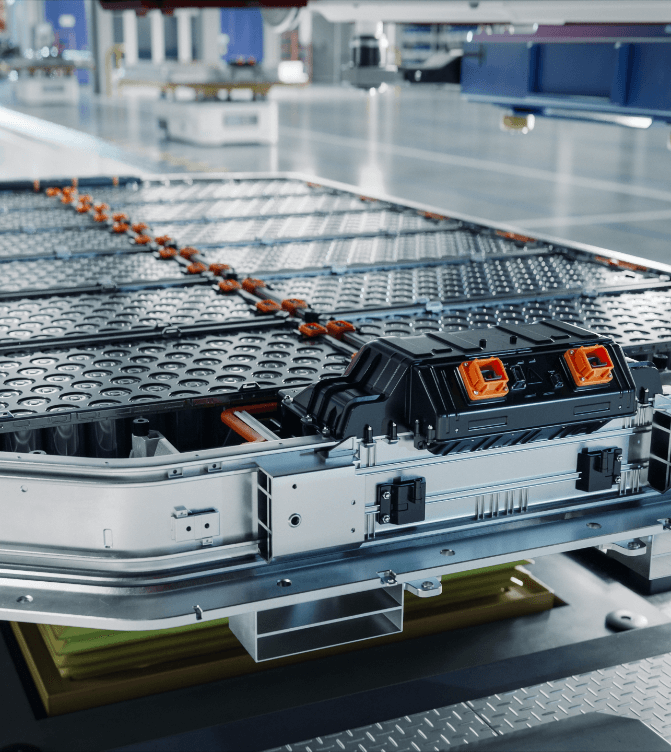
Battery manufacturing capacity can change as demand develops. Manufacturers may add production lines, introduce new battery formats, increase output or expand into energy storage applications. Each change can affect equipment, material flow and production management. For this reason, scalability is worth considering when an automated battery production system is planned.
The concept of battery manufacturing goes beyond automating individual operations. A scalable system should give manufacturers room to adjust capacity and processes while keeping equipment, controls and production information connected.
What Makes Battery Production Difficult to Scale?
Battery production involves multiple stages, from cell processing to module and pack assembly. Different stages can have different cycle times, equipment requirements and quality-control procedures. Expanding one section without considering the rest of the line may create bottlenecks instead of producing a balanced increase in capacity.
This is why battery manufacturing automation needs to be considered as a production architecture. Manufacturers need to examine how equipment communicates, how products move between stations and how production information is managed.
Product variety adds another consideration. Different cell sizes, module structures or component dimensions can require changes in positioning, tooling and process parameters. Automation designed to accommodate these variations can give manufacturers more options when specifications change.
How Can Flexible Transport Help?
Material movement is an important part of a scalable battery line. Fixed transport arrangements can become restrictive when layouts change or workpiece dimensions vary. Flexible transport technology offers another way to coordinate movement between processing stations.
FHS develops Flexible Transport Systems based on magnetic levitation technology for manufacturing applications. Its FTS-LT and FTS-MT systems are positioned for front-end and mid-stage lithium battery production, while FTS-HT is designed for back-end applications. These systems support functions including double-mover clamping, group movement and bidirectional movement.
In one module stacking application, FHS combines maglev transport with AGVs(Automated Guided Vehicle) for battery-cell loading. The system can adjust mover positions according to workpiece size and supports changeovers between different products. FHS reports a production-line cycle time of 72 PPM and a 50% reduction in footprint.
Can Modular Equipment Support Capacity Growth?
Scalability also depends on whether an automation system can expand without replacing its basic architecture. Hardware and software designed for modular expansion can provide additional flexibility when production requirements increase.
FHS states that its FTS-HT system supports modular expansion in both hardware and software. Its configuration software is iFTS-Studio, while communication interfaces include EtherCAT, Modbus/TCP, PROFINET, CC-Link, CANopen and POWERLINK. The system supports up to 255 movers and a maximum speed of 3.5 m/s.
These specifications show why transport architecture matters when a production line is expected to develop over time. Manufacturers can consider whether additional movers, modules or control functions can be incorporated into the existing system rather than treating every expansion as a completely separate project.
Why Does Product Variety Matter?
Capacity is not the only variable that can change. Battery specifications can also develop as manufacturers serve different applications. A system designed around one fixed configuration may require considerable modification when another battery design is introduced.
FHS has developed automation applications for lithium battery manufacturing, covering processes such as prismatic battery top-cover assembly, module assembly and module stacking. These applications illustrate how automation can be applied across different stages of battery production, rather than being limited to a single operation.
This type of flexibility can be relevant to manufacturers planning production over several years. The objective is not to predict every future product, but to avoid creating a system that is restricted to today’s production requirements.
What Role Does Digital Integration Play?
A scalable line also needs a control and information layer capable of managing additional equipment and changing processes. FHS’s technology portfolio includes PLC(Programmable Logic Controller) and motion control, MES(Manufacturing Execution System) software development, vision software, virtual simulation and debugging, digital twin technology and flexible transport.
These technologies can help coordinate equipment as production systems become more complex. In an energy storage cabinet production application, FHS describes a scheduling system connecting distributed equipment with MES. AGVs are used for flexible logistics, while assembly, testing and traceability processes are integrated into the production line.
For battery manufacturers, expansion therefore involves more than adding machines. Communication, scheduling, material handling and data management also need to accommodate the larger production environment.
Planning for Long-Term Battery Production
Long-term growth does not necessarily require manufacturers to install all planned capacity at the beginning. A practical approach is to identify which processes are likely to change and select equipment that can accommodate those changes.
Battery manufacturing can benefit from automation architectures combining flexible transport, modular equipment and digital control. FHS provides automation equipment and production-line solutions for power batteries, energy storage products, motors and electronic control products.
For manufacturers preparing for changing volumes or product requirements, battery manufacturing automation can be evaluated as a long-term production strategy rather than simply an equipment purchase. When scalability is considered during system planning, manufacturers have more room to adjust capacity, accommodate product variation and integrate new requirements without automatically rebuilding the entire production system.