Walk into a supermarket and then a furniture showroom on the same afternoon, and the lighting overhead is doing two very different jobs, even though both spaces are technically “retail.” One is built for fast, repeated trips down long aisles under consistent, efficient light.
The other needs to make a sofa look inviting enough to sit on for ten minutes. Treating both formats as the same lighting problem is where a lot of retrofit budgets get wasted, which is why sourcing retail lighting solutions usually works better as a format-by-format exercise than a single blanket spec.
Supermarkets and Grocery Chains
Grocery retail runs on long, repetitive aisle geometry and high ceilings, and the lighting has to stay consistent across hundreds of meters without visible dips in brightness or color.
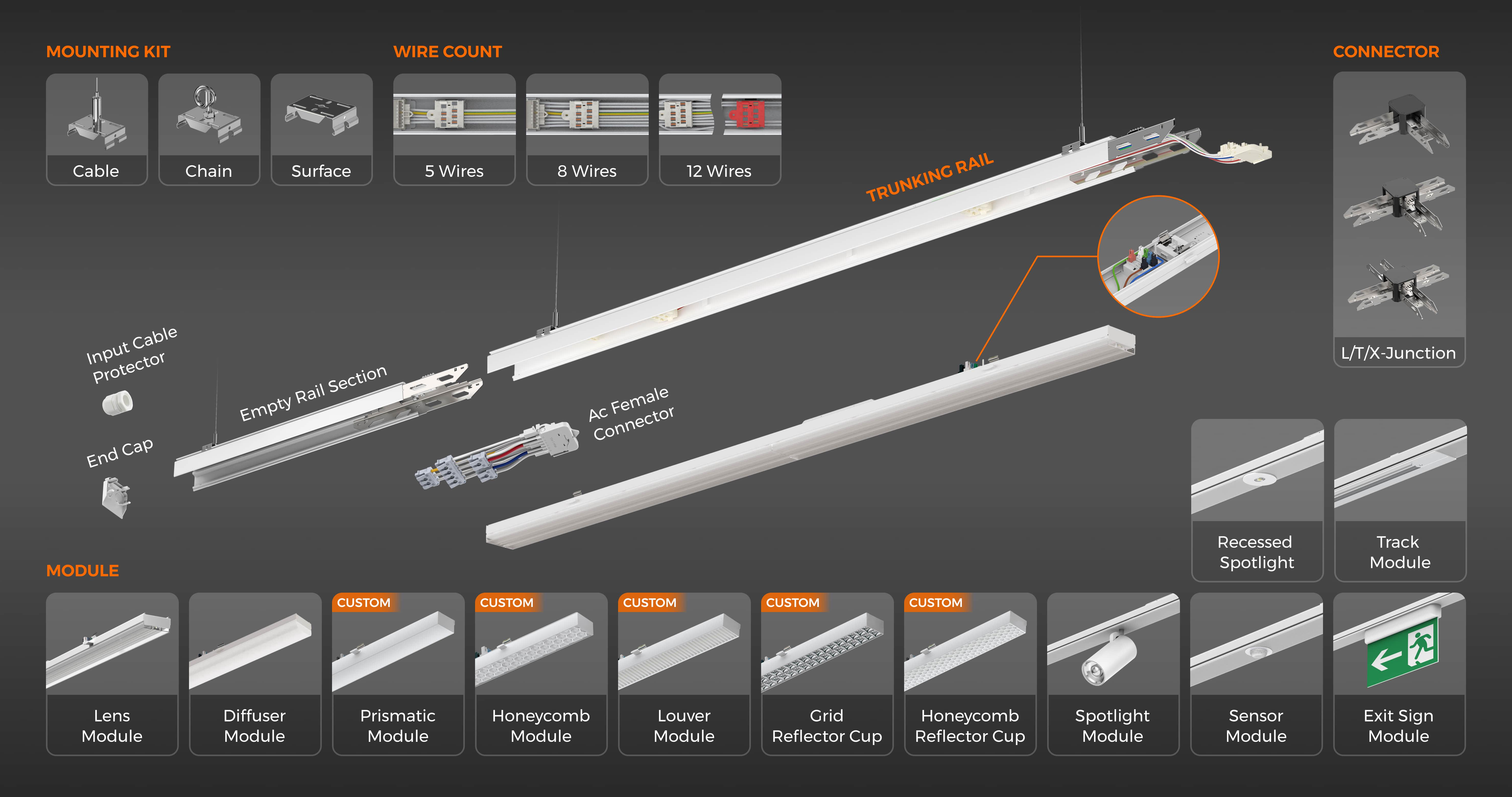
This is where trunking-based systems earn their place over standalone fixtures: a single continuous run supported by three-phase power regulation can extend past 170 meters, letting one lighting circuit cover an entire aisle block without splice points that create uneven output.
Color accuracy matters just as much here, since produce, meat, and packaged goods all rely on a color rendering index above 80 to look genuinely fresh rather than washed out under generic white light, and a unified glare rating below 16 keeps long shifts more comfortable for staff working directly beneath the fixtures all day.
Color temperature also plays a quieter role in these formats: a 4000K–5000K range tends to read as clean and neutral over produce sections, while a warmer 3000K setting is often reserved for bakery or deli counters where a softer tone suits the merchandise better.
Home Improvement and Building Material Warehouses
Large-format stores selling building materials, furniture components, or bulky hardware present a different challenge: ceilings are often higher still, aisles are wider, and merchandise sits at multiple heights from floor-level pallets to overhead racking.
TRIECO‘s Fixed Style Trunking Light System addresses this scale with a luminous flux around 11,880 lm per module at up to 180 lm/W efficacy, giving enough output to light a warehouse-height ceiling without needing an excessive fixture count.
Wide-format retail like this also benefits from the DIP switch power adjustment built into the same module range, which lets an installer dial output from roughly 30W up to 74W across seven steps on site.
That matters when one store layout has taller racking near the entrance and shorter shelving further back — the fixture body stays the same, only the configured power level changes, which keeps spare-parts inventory simpler across a chain with varying ceiling heights from location to location.
Fashion and Apparel Chain Stores
Apparel retail asks something closer to what a supermarket needs from color accuracy, but the fixture placement logic changes. Store layouts change seasonally, mannequins and racks move within weeks of each other, and glare control becomes more noticeable at eye level than it does looking up at a warehouse ceiling.
A unified glare rating below 16 keeps browsing comfortable in tighter aisles, while beam angle options ranging from a narrow 15° spot up through 120° flood settings let the same rail highlight a featured rack one week and wash an entire wall of shelving the next.
ADIDAS has applied trunking-based lighting along these lines in its South African chain stores, where reconfiguring module type and beam angle without rewiring the ceiling matters more than in a fixed grocery layout.
Tool-free module installation adds a practical benefit here too, since store staff can swap a spotlight module for a wider-beam one during a seasonal reset in seconds, without calling in an electrician.
Furniture and Big-Ticket Showrooms
Showroom retail for furniture or other large, considered purchases needs lighting that can shift between ambient fill and deliberate accenting on individual pieces, often within the same floor space.
Wire configuration becomes relevant here: an 8-wire trunking setup supporting dimming alongside emergency circuits lets a showroom dim general aisle lighting in the afternoon while keeping accent spotlights on featured items at full output, something a fixed, non-dimmable circuit can’t replicate.
In a large furniture showroom, dimming and mixed module configurations can help separate general illumination from accent lighting without requiring a completely separate lighting layer.
Matching the Store Format to the System, Not the Other Way Around
What connects these formats is less about picking a fixture and more about picking a platform that can be reconfigured as the format demands. The same underlying led light trunking rail can carry linear modules for a grocery aisle, spotlight modules for a home improvement display wall, narrow-beam accents for an apparel rack, or a dimmed, mixed layout for a furniture showroom, simply by changing which modules snap into the rail and how the wiring is configured.
For retailers weighing a retrofit across multiple store formats within the same chain, that flexibility tends to matter more in practice than any single spec sheet figure, since it determines how much of the investment carries forward the next time a format changes.