Maritime industries are paying more attention to energy efficiency, emission reduction, and compact equipment design. Vessel owners, builders, and system integrators are reviewing how onboard systems affect overall energy consumption. Air conditioning is an important part of this discussion because climate control systems operate for long periods during navigation and docking. This article explores how modern marine cooling solutions are adapting to new efficiency requirements and space limitations.
Why Energy Efficiency Matters in Modern Yacht Climate Systems
Energy management has become an important consideration in yacht design. Traditional marine equipment often requires careful power planning because available energy resources are limited. More efficient cooling technologies can help optimize unnecessary power consumption while maintaining comfortable indoor conditions.
For marine manufacturers and engineering companies, selecting suitable climate equipment involves reviewing capacity, power input, noise levels, and installation space. A properly designed yacht hvac system can support better energy planning for different vessel sizes and operating conditions.
Miniaturization is another important trend in marine equipment development. Vessels usually have limited installation areas, so compact systems are preferred by designers and shipbuilders. Smaller equipment allows more flexible interior layouts while still providing stable temperature control.
Modern marine air conditioners are moving toward integrated structures with improved components. These designs help reduce installation complexity and provide more options for yacht projects that require efficient use of available space.
How Marine HVAC Designs Adapt to Space and Power Requirements
Space utilization is a major challenge in yacht construction. Equipment rooms, cabins, and entertainment areas all require careful planning. Compact air conditioning units with efficient internal structures can help engineers arrange systems more effectively.
DC inverter technology has become a practical option for marine applications. Compared with traditional fixed-speed systems, inverter solutions can adjust operation based on cooling demand. This approach helps reduce energy waste and supports smoother performance during different usage periods.
Another important factor is durability in marine environments. Saltwater exposure may affect equipment materials over time. For this reason, corrosion-resistant components, protective coatings, and suitable housing materials are often considered during equipment selection.
The development of compact climate systems also focuses on user convenience. Remote operation, adjustable airflow, and simple maintenance designs provide additional value for boat operators and service teams. These features help simplify daily management after installation.
Product Example: Compact Cooling and Heating Solution for Marine Applications
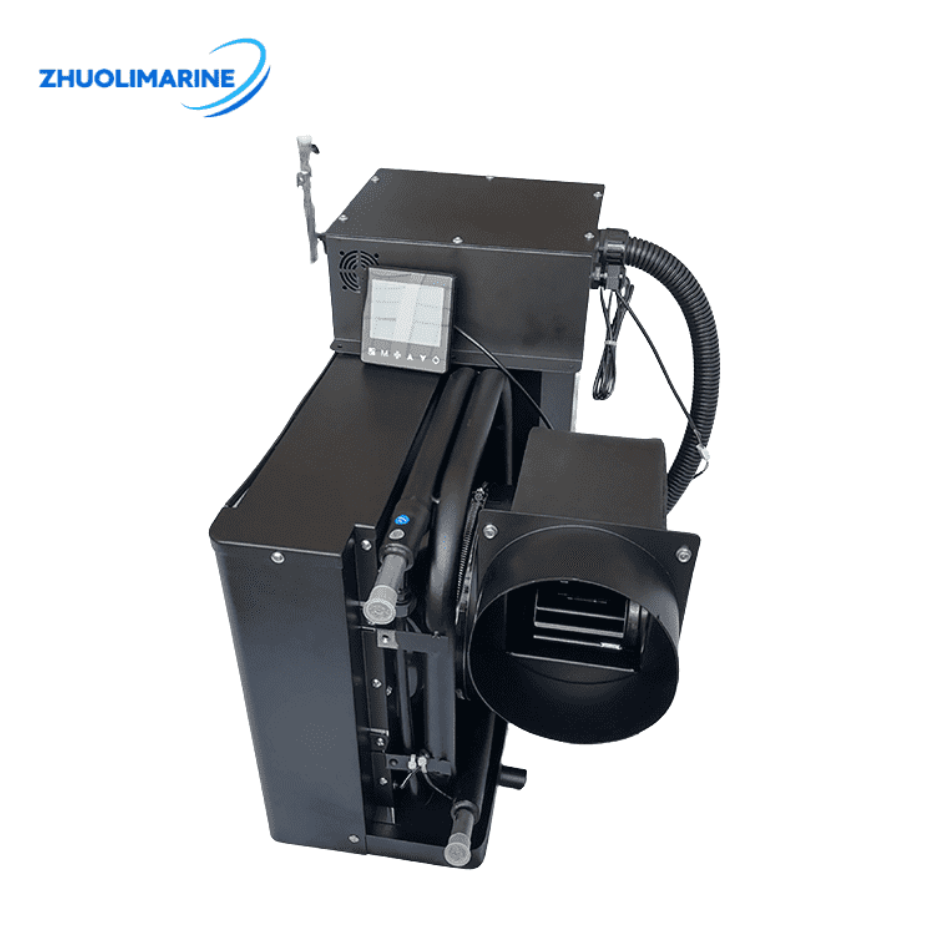
When selecting marine air conditioning equipment, buyers usually review cooling capacity, heating performance, material quality, and control functions. ZhuoliMarine provides the MAR-12V/12BP Yacht Air Conditioner, which is designed for yacht applications.
The MAR-12V/12BP delivers 12,000 BTU cooling capacity and 12,250 BTU heating capacity. It uses a DC-12V power supply with full DC inverter technology. The system includes a titanium alloy condensation tube heat exchanger and 304 stainless steel housing, supporting corrosion resistance in marine environments.
The unit also features an IP68 waterproof centrifugal motor for reliable operation with reduced noise. A WiFi remote control function allows convenient management, while the 360° adjustable blower supports flexible airflow direction. The replaceable air filter helps maintain cleaner airflow and simplifies regular maintenance.
For marine projects, these specifications provide a reference for evaluating equipment performance. The combination of compact structure, energy-focused operation, and marine-oriented materials matches the needs of applications where space and durability are important factors.
Material Selection and Maintenance Considerations for Marine Equipment
Material selection directly influences the service life of yacht equipment. Components exposed to seawater environments require careful consideration because humidity and salt exposure may affect mechanical parts and external surfaces.
The MAR-12V/12BP uses a 304 stainless steel housing and titanium alloy heat exchanger design. These materials are selected for their resistance characteristics and suitability for marine conditions. The system also supports R134a and R410a refrigerants for cooling operation.
Maintenance planning is also important for marine operators and service providers. Regular inspection of filters, airflow paths, and electrical connections can help maintain stable operation. Equipment with accessible maintenance structures may reduce service difficulty during long-term use.
As maritime industries continue to focus on efficient systems, manufacturers are exploring designs that combine compact dimensions with practical performance. This direction reflects changing requirements from yacht builders, distributors, and engineering companies.
Future Trends in Yacht HVAC Technology and Marine Applications
Future yacht climate solutions are expected to continue developing toward lower energy consumption and smarter control functions. Compact equipment, digital management, and improved materials are becoming important considerations in marine engineering projects.
For commercial partners, understanding these trends helps them select products that match customer requirements. Energy efficiency, installation flexibility, and maintenance convenience are key factors when evaluating marine air conditioning solutions.
ZhuoliMarine focuses on the research, development, and manufacturing of marine climate control products. They provide yacht air conditioning solutions with features such as DC inverter technology, corrosion-resistant structures, smart control options, and customized application support. Their products are designed to meet different marine environment requirements through practical engineering solutions.
For companies seeking reliable marine climate solutions, exploring suitable equipment options with ZhuoliMarine can help support future yacht projects and system integration needs. Contact their team to discuss your application requirements and find a suitable solution.