For distributors serving retail chains, shopping malls, exhibitions, hospitality businesses, and brand activation agencies, choosing a reliable display manufacturer is a strategic decision. Beyond product appearance, the right supplier must deliver consistent quality, practical installation features, dependable technical support, and products that meet customers’ commercial requirements.
An LED poster display can help businesses deliver dynamic advertising without the fixed installation requirements of many conventional digital signage systems. However, not every model offers the same portability, content management options, or multi-screen capabilities. Distributors should assess the manufacturer’s technical expertise, product specifications, quality control, and customization potential before committing to a supplier relationship.
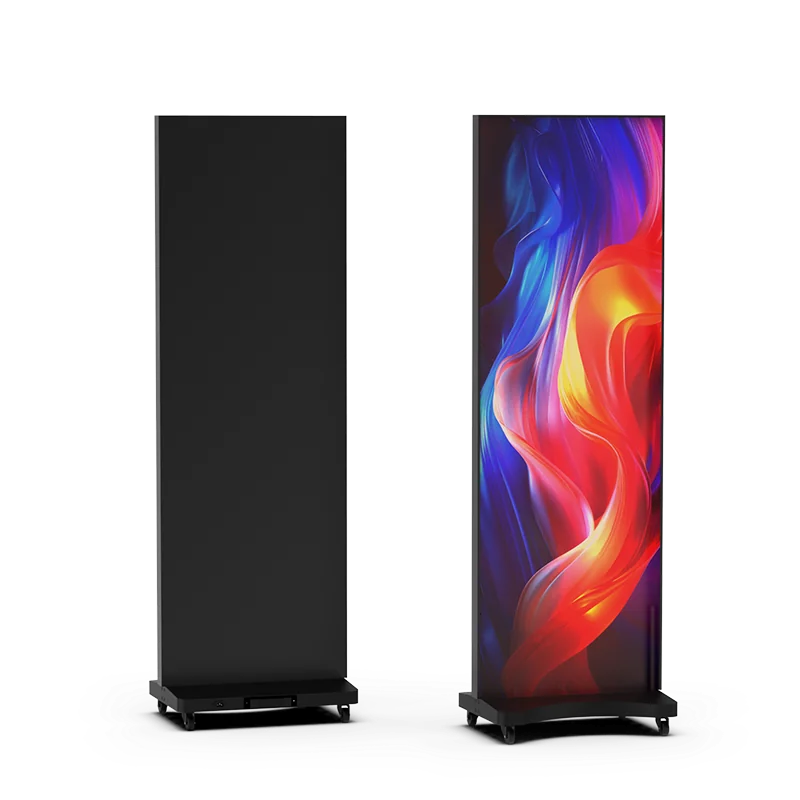
HDC, a high-tech enterprise integrating research and development, manufacturing, sales, and service for creative and commercial LED displays, offers an all-in-one LED poster display designed around portability, straightforward operation, and flexible screen configurations.
Assess Product Design and Commercial Usability
Distributors should begin by examining whether a product addresses practical customer needs. For retail and exhibition applications, portability, quick setup, and a compact footprint can be important selling points, particularly when customers frequently change advertising locations or operate temporary promotional spaces.
HDC’s all-in-one model is designed with a thickness of just 61 mm, making it relatively slim for transport and placement. Its foldable structure also helps reduce storage requirements and simplifies transportation. These features can make the product relevant to distributors serving pop-up stores, showrooms, shopping centers, and event organizers.
Usability matters just as much as appearance. A display that can be powered on and used with minimal setup may reduce operational complexity for customers without dedicated AV technicians. Distributors should nevertheless confirm the unit’s actual weight, folded dimensions, transport accessories, and setup procedure before promising specific handling benefits.
Verify Display Performance and Technical Specifications
Visual performance directly affects customer satisfaction and the suitability of a display for different environments. A manufacturer should provide clear technical documentation covering pixel pitch, resolution, brightness, refresh rate, viewing angles, power consumption, and operating conditions.
HDC’s all-in-one LED poster display uses full-color LED technology and is designed to deliver high brightness, a high refresh rate, and a wide viewing angle. These characteristics support dynamic advertising and help content remain visible to audiences approaching from different directions. However, distributors should request numerical specifications for each offered model instead of relying solely on general performance descriptions.
Compatibility is another important consideration. Buyers should establish which input interfaces, control systems, content formats, and operating methods are supported. Verified documentation makes it easier for distributors to answer technical questions, prepare accurate quotations, and avoid compatibility problems after delivery.
Examine Content Management and Multi-Screen Capabilities
For commercial customers, updating content should be straightforward. Promotional campaigns can change frequently, so complicated publishing procedures may discourage regular use and increase support requests.
HDC’s all-in-one design incorporates a built-in media player with content update options including USB drives, Wi-Fi, and a mobile application. It also supports standalone playback, allowing one unit to operate independently without requiring a larger display installation.
Multi-screen connectivity provides another sales opportunity. Multiple units can be connected and synchronized to create a larger digital advertising wall for product launches, retail campaigns, and temporary brand stores. Distributors evaluating an LED poster display should test synchronization, screen alignment, content scaling, and playback consistency before recommending a multi-unit configuration.
They should also clarify whether the manufacturer’s control software supports the customer’s intended workflow. Features such as remote content management, user permissions, and scheduled playback should be confirmed against the actual product documentation rather than assumed to be included.
Evaluate Manufacturing Quality and Supplier Reliability
A competitive quotation is not enough to establish a dependable supplier relationship. Distributors need evidence that the manufacturer can deliver consistent products, communicate specifications accurately, and handle quality issues through a defined process.
Useful evaluation steps include requesting product datasheets, inspection procedures, applicable certifications, sample units, and written warranty terms. A factory visit or remote production audit may also help establish which manufacturing processes the supplier controls directly and how finished products are inspected.
Lead times and spare-parts availability deserve similar attention. Before placing a bulk order, distributors should confirm production schedules, packaging arrangements, shipping responsibilities, replacement-part procedures, and the process for handling defective units. These details affect inventory planning and the distributor’s ability to support downstream customers.
HDC’s role across research and development, manufacturing, sales, and service provides a basis for discussing product requirements with one supplier. Prospective partners should still verify the specific commercial terms, quality documentation, and after-sales arrangements applicable to their orders.
Compare Total Cost and Long-Term Business Potential
The lowest purchase price does not necessarily deliver the best margin. Distributors should calculate the total cost of acquiring, storing, shipping, demonstrating, and supporting each product. Packaging dimensions, freight costs, spare inventory, warranty exposure, and training requirements can all influence profitability.
A foldable, lightweight design may help reduce storage and handling burdens, but the actual financial benefit depends on the product’s dimensions, shipping method, and order volume. Distributors should compare these costs using realistic logistics quotations rather than relying on design descriptions alone.
Market fit is equally important. A versatile LED poster display may appeal to several customer segments, but distributors should identify the strongest local applications and expected price range before building inventory. Demonstration units, clear sales materials, technical training, and responsive manufacturer communication can help support repeat business.
Choosing a Manufacturer for Sustainable Distribution Growth
Selecting an LED display supplier requires a balanced assessment of product performance, design, manufacturing consistency, technical support, and commercial viability. Distributors that verify specifications and test real-world usability are better positioned to recommend suitable products and manage customer expectations.
HDC’s all-in-one LED poster display offers features including a 61 mm slim profile, foldable construction, multiple content update methods, and synchronized multi-screen connectivity. For distributors targeting retail, exhibitions, and promotional environments, these capabilities provide a starting point for evaluating product-market fit.
Ultimately, a successful partnership depends on more than an attractive product. Verified specifications, transparent terms, reliable supply, and clearly defined after-sales support help distributors build customer confidence and develop a sustainable commercial display business.