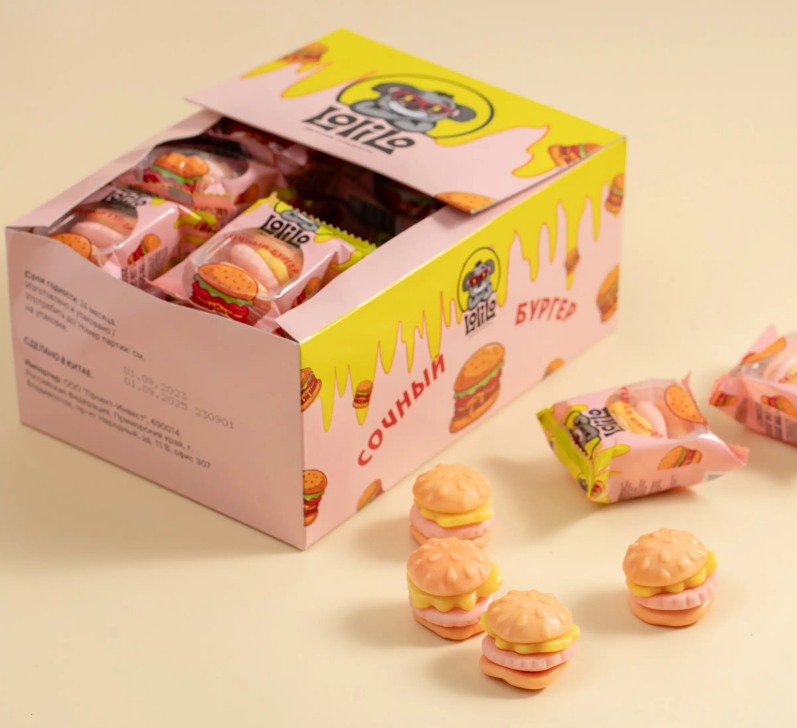
In contemporary retail environments, the physical space allocated to individual confectionery SKUs frequently shrinks as operators optimize their checkout zones. Single-serve and impulse-sized packages increasingly dominate sales volume, yet their smaller physical footprint introduces a fundamental marketing challenge. A product weighing mere fractions of an ounce must somehow command sufficient visual attention to earn a place in a consumer’s shopping basket. A well-designed burger gummy candy answers this challenge through a principle that might appear counterintuitive: shelf stopping power relies heavily on design density rather than sheer size. A compact 28-gram novelty item replicating four distinct food layers in vivid colors generally achieves more visual impact than a much larger 200-gram bag containing monochromatic standard shapes. For commercial distributors and any strategic wholesale candy supplier, understanding why this small-format novelty performs so efficiently is essential for building profitable impulse assortments.
The Structural Challenge of Small-Format Confectionery
The global consumer shift toward continuous snacking and portion control has notably compressed average candy packaging formats. Convenience store operators, vending machine purveyors, and e-commerce sample programs increasingly favor unit weights between 10 and 30 grams. While this industry trend benefits inventory turnover rates and improves price accessibility for the end consumer, it intensifies the battle for visual attention within a rapidly shrinking physical display canvas.
Standard confectionery shapes, such as traditional rings, worms, or bears, frequently lose their visual differentiation as package sizes decrease. At a 15-gram scale, a single-color piece often registers merely as a nondescript shape in a shopper’s peripheral vision, easily blending in with neighboring competitors. The product that typically survives this miniaturization process is one whose structural form and color palette carry enough information density to remain instantly recognizable, even at a considerably reduced scale.
How Multi-Color Layering Creates Visual Density at Small Scale
The layered burger form holds a unique structural advantage for small-format retail impact because it compresses four distinct color zones into one compact object. By combining a golden bun, a brown patty, green lettuce, and red tomato details, the polychromatic construction creates a visual signature that remains highly legible, even when enclosed in transparent packaging no larger than a standard credit card. Where monochromatic geometries often dissolve into generic color fields at a distance, layered food replicas retain their identity because the human brain processes the complex pattern rather than just a single hue.
Recognizing this dynamic, HAPI manufactures high-quality burger gummy candy across multiple specifications, ranging from compact 10g individual packs to substantial 90g giant formats. The production facility employs advanced sequential multi-layer depositing techniques that preserve sharp color boundaries, even at miniature scales. This manufacturing precision ensures that the product’s primary visual selling proposition survives the transition from a large bulk display down to a tiny single-serve sachet.
Packaging Architecture and the Visual Selling Proposition
For visually driven novelty products, the chosen packaging architecture acts either as an amplifier or an obstruction. Opaque wrappers effectively neutralize the primary competitive advantage of a detailed burger gummy candy, rendering it visually indistinguishable from any other small sweet on the shelf. Successful retail execution generally demands transparent films, windowed cartons, or clear bulk-bin displays where the item can speak for itself. Within the 10-to-30-gram segment, the physical candy piece must carry a significant majority of the sales communication burden.
Gravity-feed dispensers present a unique dynamic advantage for three-dimensional novelty shapes in high-traffic retail zones. As the products tumble and rotate within a clear column, the multi-layer construction of these layered sweets creates shifting color perspectives that attract wandering shopper attention. Flat-display trays, by contrast, tend to freeze the product in a single orientation, which requires more thoughtful merchandising efforts to ensure the most colorful, layered face remains clearly visible to passing consumers.
The Neuroscience of Food Recognition in Compact Forms
Familiar food shapes may help shoppers recognize novelty confectionery at a glance. However, the extent to which a particular design attracts attention depends on factors such as packaging, display position, and the surrounding products. This hardwired neural recognition pathway frequently triggers an immediate positive affect response before any conscious evaluation of the product occurs. A confectionery item that successfully activates this pathway gains a cognitive head start that abstract or geometric sweet shapes generally cannot replicate in a busy retail environment.
The emotional payload of food-shaped treats operates on multiple demographic registers simultaneously. Children typically respond to the high color saturation and form playfulness, while adolescents often engage with the ironic humor of a savory fast-food icon rendered entirely in sugar. Furthermore, adult demographics frequently experience nostalgic associations linked to childhood toy food. This multi-generational emotional resonance helps amplify the initial visual impact into a deeper motivational force that drives impulse purchasing.
Scaling Visual Impact Across Omnichannel Retail
While physical retail relies heavily on shelf-level visual interception, e-commerce and social commerce platforms operate through entirely different visual economies. Digital thumbnail images, unboxing videos, and user-generated social content demand products that photograph with clear dimensional presence. A structured burger gummy candy often outperforms flat or abstract shapes in these digital contexts because its layered construction creates natural shadows, depth, and color contrast that translate powerfully to two-dimensional screens.
For wholesale candy supplier networks serving multi-channel retail organizations, product curation must account for this visual portability. A novelty item that performs adequately in physical displays but photographs poorly limits a digital retailer’s marketing toolkit. Conversely, a distinct shape that succeeds across in-store shelves, online catalogs, and social media feeds delivers notable marketing efficiency without requiring massive additional investments in digital content production.
Sourcing Visually Precise Novelty Candy for Consistent Shelf Impact
Procurement teams evaluating novelty candy suppliers must prioritize visual specs alongside flavor and texture. Critical factors include sharp color boundaries between layers, batch-to-batch color consistency, three-dimensional structural integrity, and surface gloss that preserves appeal under retail lighting. These parameters are easy to verify in samples but notoriously difficult to maintain across production runs of 100,000+ units.
HAPI addresses this consistency challenge through automated production lines with fifth-generation starch molding technology and computer-controlled depositing systems that maintain layer precision at daily volumes of up to 30 metric tons. As a wholesale candy supplier with 25 years of international confectionery experience, HAPI holds FSSC 22000 and ISO 22000 certifications and has passed a 2025 SEDEX audit. HAPI offers gummy manufacturing and OEM services for commercial buyers. Before placing an order for burger-shaped gummies, buyers should confirm the available product formats, applicable production capacity, quality specifications, and delivery schedule for their project.