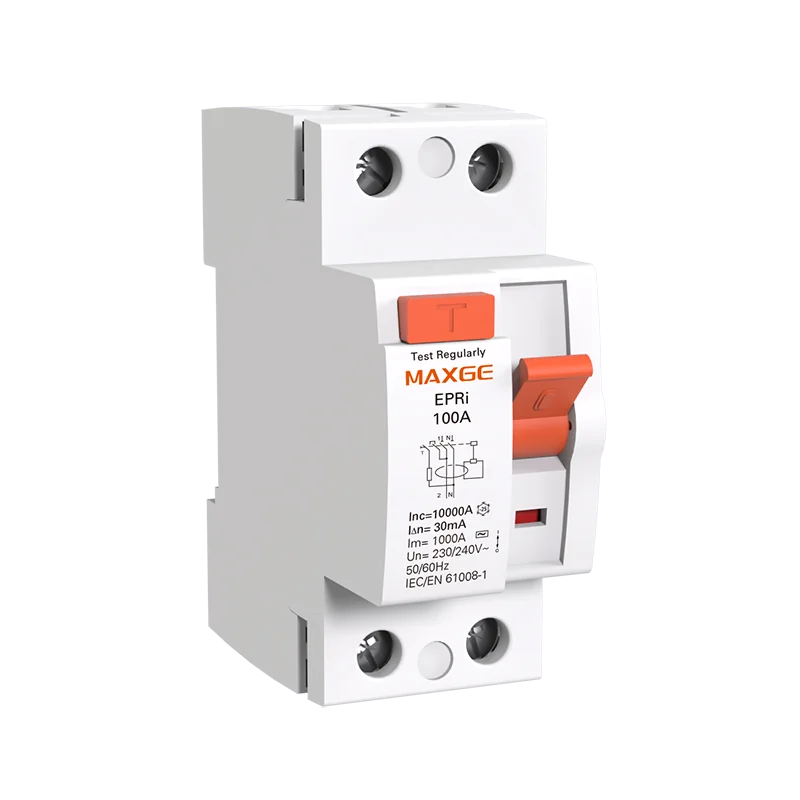
Electrical safety systems often need to address more than one type of fault. Overcurrent can damage conductors and equipment, while residual current may indicate leakage that creates a risk of electric shock or electrical fire. For this reason, selecting suitable electrical control products requires an understanding of how different protection functions work together.
An RCBO, or residual current circuit breaker with overcurrent protection, combines residual current protection and overcurrent protection in a single device. This integrated approach can simplify circuit protection while helping electrical systems respond appropriately to different fault conditions.
What Is an RCBO?
An RCBO is a protective switching device designed to detect both residual current and excessive current. Its residual current function monitors the balance of current flowing through the circuit. When leakage exceeds the device’s specified threshold, the RCBO can disconnect the circuit.
At the same time, its overcurrent protection responds to conditions such as overloads and short circuits. This means a single device can provide functions that would otherwise require separate residual current and overcurrent protective devices.
For installers and system designers, this combination can make circuit protection easier to organize. It can also help reduce the space required inside distribution boards, particularly where multiple outgoing circuits need individual protection.
Why Combine Residual Current and Overcurrent Protection?
Traditional protection arrangements may use an RCD together with a miniature circuit breaker. While this approach can be effective, an RCBO provides individual protection for each circuit within one device.
This distinction is important in installations where circuit separation matters. If a fault occurs on one protected circuit, the corresponding RCBO can disconnect that circuit without necessarily interrupting other independently protected circuits.
An RCBO can therefore support more selective circuit protection and help make fault identification more straightforward. For commercial buildings, residential distribution systems, equipment installations, and other applications, this can contribute to a more organized protection strategy.
Understanding Residual Current Protection
Residual current occurs when some current flows through an unintended path rather than returning through the expected circuit conductors. This can happen because of insulation deterioration, damaged wiring, moisture, or an electrical fault involving a person.
A residual current circuit breaker detects an imbalance between the current flowing through the conductors. When the difference reaches its rated residual operating current, the device trips and disconnects the circuit.
The required sensitivity depends on the application and applicable electrical standards. Therefore, selecting a device should involve more than simply choosing the lowest available trip value. System design, circuit characteristics, installation conditions, and local requirements should all be considered.
How RCD Types Affect Device Selection
Understanding RCD types is another important part of selecting suitable protection. Different RCD classifications are designed to respond to different forms of residual current, including currents associated with modern electronic equipment.
Equipment containing power electronics, variable-speed drives, switching power supplies, or other electronic components can produce current waveforms that influence protective-device selection. The appropriate RCD type should therefore be determined according to the characteristics of the connected load and the requirements of the installation.
An RCBO should also be selected according to important electrical parameters such as rated current, voltage, breaking capacity, residual operating current, pole configuration, and applicable standards. These specifications should match the circuit rather than being chosen solely according to physical dimensions or nominal current.
Residual Current Breaker With Overload Protection: What to Check
When comparing a residual current breaker with overload protection, users should look at both protection functions and overall system compatibility. The overload function should correspond to the expected continuous load and conductor capacity, while short-circuit protection should be suitable for the prospective fault current at the installation point.
It is equally important to consider installation space, terminal configuration, operating characteristics, and coordination with upstream and downstream protective devices. A technically suitable device should also fit the distribution board and wiring arrangement used in the project.
For projects involving multiple circuits or different types of loads, reviewing the complete protection scheme before purchasing can help avoid compatibility issues and unnecessary replacement work.
Choosing Electrical Control Products for Reliable Protection
Electrical control products should be selected as part of an overall electrical design rather than as isolated components. Protection requirements, connected equipment, installation environment, standards, and maintenance considerations all influence the appropriate solution.
MAXGE provides a range of electrical protection and control products for different electrical applications. Reviewing product specifications before selection can help users compare relevant ratings and functions according to their project requirements.
For technical specifications, product selection assistance, or application-related questions, users can contact MAXGE directly for further information.
Making the Right Protection Choice
An RCBO combines residual current protection and overcurrent protection in one compact device, making it a practical option for circuits where both functions are required. However, effective protection still depends on selecting device characteristics that correspond with the electrical system, including rated current, residual current sensitivity, tripping characteristics, and installation conditions.
By considering residual current protection, RCD types, overload requirements, and circuit conditions together, users can make more informed decisions when evaluating electrical control products. MAXGE provides low-voltage protection solutions for different terminal and distribution applications, with its product development supported by an R&D team, patented technologies, software copyrights, and testing capabilities including CNAS-related laboratory resources and international certifications.
For RCBO specifications, technical inquiries, or application requirements, you can contact MAXGE through its official website to discuss suitable protection options for your electrical system.