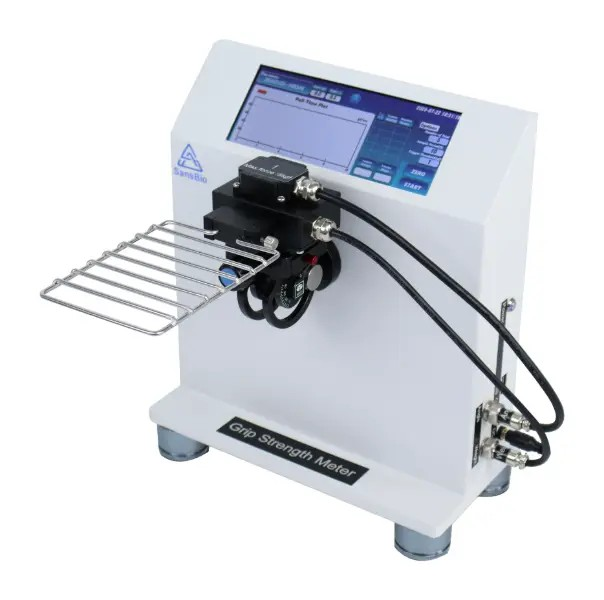
Grip strength measurements can provide a functional endpoint in studies involving muscle performance, motor control, neuromuscular function, and related conditions. For mouse experiments, the instrument needs to fit the testing method as well as the data workflow.
Force range, grip attachments, testing geometry, trial management, and data export are useful comparison points when laboratories assess equipment for baseline studies, treatment groups, or repeated measurements.
Start With the Measurement Setup
Before comparing specifications, decide how the animals will be tested. A mouse grip strength meter may be used for forelimb or hind-limb assessments, depending on the experimental endpoint. The Grip Strength Meter Pro is designed for both forelimb grip strength testing and hind-limb protocols in mice and rats.
The pulling procedure is also relevant. During testing, the animal grips a bar or mesh grid connected to a force transducer. The researcher gradually pulls the animal until the grip is released, while the system records the maximal tensile force. Keeping the procedure and test variables documented helps place each result in context.
Look Closely at Force Measurement
Force range and resolution should match the animal model and expected measurements. The SA415 Pro provides a 0–1000 g (10 N) measurement range for mice and 0–5000 g (50 N) for rats. Its force resolution is 0.1 gf, while the listed accuracy is ±0.1% Full Scale (FS).
The system also supports several measurement units, including gf, N, and pounds-force. The manufacturer recommends using gf for mouse measurements. Integrated force calibration is included, allowing researchers to perform calibration within the grip strength meter.
Compare the Available Grip Attachments
The contact surface is another specification worth examining because different testing configurations may call for different attachments. The SA415 Pro includes seven interchangeable grip attachments: two mesh grids and five triangular bars.
For mice, the mesh grid measures 9 × 12 cm and the bar diameter is 0.20 cm. Mouse triangular bars come in 6 × 7 cm formats with bar diameters of 0.20 cm and 0.15 cm. These options give researchers several physical setups to consider when planning forelimb or hind-limb measurements.
Review Testing Geometry
The angle between the animal and the force sensor can also be part of the protocol. The SA415 Pro supports a 90° adjustment range, with a sensor resolution of 0.1°. Establish the intended angle before data collection and document it as part of the test method.
During testing, hold the animal by the tail or neck skin, move it toward the grip bar or grid, and pull along the sensor axis until the grip is released. After testing, clean the grip grid or pull bar with alcohol.
Plan for Repeated Trials
Repeated measurements require more than a peak value on the screen. The SA415 Pro supports up to 20 trials per session and automatically records each trial’s curve, peak force, and duration. Researchers can also view real-time grip-force curves and average values on the 6.8-inch HD capacitive touchscreen.
These functions can be useful when a protocol includes multiple attempts per animal. Before testing begins, establish the number of trials, interval between attempts, and rule for selecting or summarizing the reported result.
Check How Data Moves Into Analysis
Data management becomes more important as the number of animals and trials increases. The SA415 Pro stores up to 2,000 records and keeps subject information such as ID, age, weight, sex, grouping, and remarks. Data history can be reviewed directly on the device.
Results can be exported through a USB flash drive in CSV format for further analysis. The system also provides threshold-based automatic recording and a 1000 Hz sampling rate, giving researchers additional information when reviewing individual grip-force traces.
Consider the Laboratory Workflow
A mouse grip strength meter should fit the way the laboratory actually works. The SA415 Pro can operate as a standalone system, with commands available through the touchscreen or foot switch. This setup allows researchers to conduct measurements without requiring a computer connection during every test.
The laboratory animal and neuroscience research equipment range is built by BioMed Easy Technologies, a subsidiary of SANS Biotechnology. Company records trace the manufacturing center from 2,200 m² of R&D and manufacturing space in 2017 to more than 7,000 m² in 2024.
The official website also lists CE and ISO9001 certifications and support for more than 3,000 laboratories globally.
Its portfolio includes systems for motor coordination, pain, learning and memory, anxiety, fear and emotion, reward and addiction, and video tracking. The company also provides technical support, training, and after-sales service, giving laboratories practical assistance when setting up or operating research equipment.
Mouse-specific force specifications, interchangeable attachments, adjustable testing geometry, repeated-trial recording, and onboard data management make the SA415 Pro a fit for laboratories comparing grip-strength systems.
After reviewing the official specifications, laboratories can discuss configuration and workflow requirements for a mouse strength study with the BioMed Easy team.