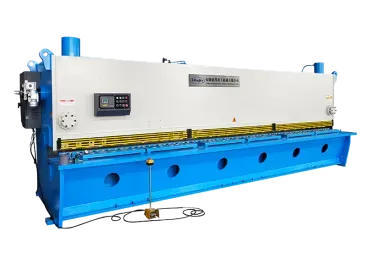
A guillotine shearing machine cuts sheet metal along a straight line by moving an upper blade past a fixed lower blade while the workpiece is held in position. Unlike laser or plasma cutting, it does not follow a free-form programmed contour. Its purpose is controlled blanking of sheets into panels, strips, and other straight-edged pieces.
Within sheet metal fabrication equipment, the guillotine shear works mainly as a preparation machine. It often sits before bending, rolling, punching, or welding, where accurate blank size matters more than complex profile geometry.
How Does the Guillotine Cutting Cycle Work?
The cycle begins with positioning. The sheet is moved to the required dimension, usually with the help of a back gauge or another reference. Hold-down devices then secure the material so it does not shift when the blade enters the sheet.
Next, the upper blade travels past the lower blade and creates the shearing force that separates the material. Blade clearance and cutting angle have to suit the material and operating conditions. After the stroke, the blade returns and the machine is ready for the next blank.
RBQLTY’s guillotine shear pages describe hydraulic machines with back-gauge control, hold-down cylinders, blade-gap adjustment, cutting-angle functions, and table support features on selected models.
This sequence shows why the machine is more than a pair of blades. Each step has a separate function, and poor control at one stage affects the quality of the finished blank. Positioning, clamping, blade movement, and material support all contribute to the quality and consistency of the cut.
Which Parts Control the Shearing Process?
Several systems work together during each cycle. The frame supports the cutting assembly. The hydraulic or drive system produces motion. The blades perform the separation, while the hold-down system keeps the sheet stable.
The back gauge establishes the target dimension, and the worktable supports material during feeding. Blade gap deserves particular attention. It is the clearance between the cutting edges, and the setting changes with the material and job.
Cutting angle is another important factor because it affects how the moving blade engages the sheet across its width. Controls determine how positioning and other settings are managed.
RBQLTY lists ESTUN E21S as well as other optional CNC systems on selected guillotine models, with functions related to positioning and programmable operation. A guillotine shearing machine should therefore be evaluated as a coordinated mechanism.
Accurate cutting depends on the interaction between positioning, hold-down, blade condition, adjustment, and support rather than nominal capacity alone. Blade condition also deserves routine attention.
Worn or damaged cutting edges change the way the sheet separates, so blade inspection forms part of maintaining a stable shearing process.
Where Does a Guillotine Shear Fit in Sheet Metal Fabrication Equipment?
The process works best when the required part can be produced through straight cuts. Typical examples include rectangular blanks, strips, panels, and material prepared for a later forming operation. Because the blade travels across a straight line, the machine is well matched to work that does not require complex contours at this stage.
Curves, internal holes, and irregular outlines usually belong on laser, plasma, punching, or another process designed for more flexible geometry. This division of work helps a fabrication shop use each machine according to its cutting principle.
A workshop does not need every cutter to perform every task. Sending direct straight blanking to a shear leaves programmable cutting equipment available for work that genuinely requires contour flexibility.
The downstream operation also influences the way the shear is used. A blank going to a press brake requires reliable dimensions and organized stacking. Strips prepared for rolling place different demands on handling.
In both cases, the value of the shear depends partly on how smoothly the material moves into the next process.
How Is a Guillotine Shear Different from Other Cutting Machines?
The clearest comparison is the type of cutting motion.
| Machine | Main Cutting Logic | Typical Geometry |
| Guillotine shear | Blade passes another blade across a straight line | Panels, strips, rectangular blanks |
| Fiber laser cutter | CNC-guided beam follows a digital path | Contours, holes, curves, nested profiles |
| Plasma cutter | CNC-guided plasma arc follows a programmed path | Straight or complex profiles in suitable metals |
The comparison is about process capability, not a universal ranking. A guillotine shear is often the most direct choice for repeated straight blanking even when a laser or plasma cutter is available in the same factory.
RBQLTY supplies guillotine and swing-beam shears as well as laser and plasma cutting equipment. This product mix reflects the different roles of these machines within sheet metal fabrication equipment rather than suggesting that one cutting method replaces all others.
Conclusion
A guillotine shear performs a defined task: it positions, clamps, and cuts sheet along a straight line. RBQLTY includes guillotine shears in its broader metal-processing range, alongside cutting systems designed for more complex geometry.
Blade clearance, cutting angle, back-gauge accuracy, hold-down action, and material support determine how well the shear performs its role before bending, rolling, punching, or assembly.