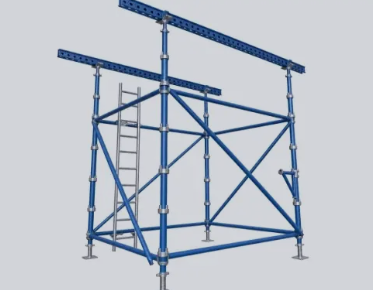
Engineering complex temporary access frameworks for intricate civil infrastructure or energy installations demands structural versatility without sacrificing overall load integrity. Modern construction sites frequently encounter irregular geometries, tight clearance constraints, and varying elevation profiles that traditional tube-and-coupler methods struggle to accommodate efficiently. Deploying an engineered modular scaffolding system enables contractors to build highly adaptable spatial configurations using uniform components, vastly accelerating jobsite erection times while maintaining uniform safety margins.
When site supervisors evaluate temporary access strategies for specialized industrial projects, understanding how standardized node geometry and standardized component dimensions interact becomes vital for optimizing labor efficiency. Equipment produced by a certified scaffolding manufacturer like Rongze offers precision engineering that empowers technical teams to erect custom access matrices across demanding industrial job sites.
Geometric Versatility Through Standardized Connection Nodes
Interconnecting structural members at fixed node points forms the technological core of modern prefabricated access frameworks. Rather than relying on friction clamps that require labor-intensive manual torque checks, prefabricated node designs utilize engineered rosettes or cup sockets spaced at precise vertical intervals along standards. Inserting ledger ends and diagonal bay braces directly into these connection points creates rigid right-angle grid structures capable of following complex building contours. This geometric standardization eliminates guesswork during assembly, allowing site crews to construct circular, cantilevered, or stepped frameworks with high structural accuracy.
Structural adaptability proves particularly beneficial when surrounding irregular architecture or rounded industrial vessels. The fixed geometry of modern node points allows horizontal ledgers to radiate outward at multiple predetermined angles from a single vertical standard without compromising joint stability. Consequently, engineering teams can design tight-fitting perimeter scaffolds that provide secure working decks around curved surfaces, high-voltage turbines, or tapering industrial towers. Maintaining close proximity to structural work zones improves ergonomic access for technicians while reducing reliance on custom field fabrications that could introduce structural vulnerabilities.
Load Dispersion Mechanics in Standardized Component Assemblies
Transferring substantial dead weights and dynamic operational loads safely to ground foundations represents a primary design objective for temporary work installations. Standardized modular systems utilize high-yield carbon steel tubes engineered to handle high axial compression and lateral shear stresses simultaneously. The uniform wall thickness of standardized vertical standards ensures predictable mechanical behavior under full rated capacity, preventing localized buckling under eccentric load conditions. Calculating total load-bearing limits becomes straightforward when every structural member adheres to identical metallurgical and geometric specifications.
Integrating primary load distribution components, such as heavy-duty base plates and adjustable screw jacks, protects the supporting ground surface from localized soil compression or concrete crushing. Screw jacks allow installation crews to make fine height adjustments at foundation level, compensating for uneven terrain while ensuring all vertical standards remain plumb throughout the build. Maintaining strict vertical alignment across every standard minimizes bending moments along the uprights, maximizing the overall load-bearing capability of the framework.
Manufacturing Precision and Structural Quality Control
Maintaining tight manufacturing tolerances across full production batches represents the foundation of reliable field performance for temporary construction equipment. Minor variations in vertical ledger lengths or rosette placement can introduce internal stress concentrations when components are forcibly aligned during assembly. Advanced manufacturing facilities employ automated robotic welding lines to create continuous, full-penetration welds around connection nodes, preventing hidden cold joints that could fail under dynamic impact loads.
Sourcing verified inventory from an established scaffolding manufacturer gives site engineers complete confidence that supplied materials adhere to international structural standards. Comprehensive factory testing documentation confirms ultimate tensile strength, yield limits, and permissible load ratings under various environmental conditions. Establishing traceability from raw steel billet to finished structural component minimizes operational risks on complex civil and industrial construction projects worldwide.
Protective Coatings and Long-Term Environmental Resistance
Exposing temporary structural steel to moisture, chemical fumes, and marine atmospheric conditions creates significant corrosion risks that can compromise load capacity over time. Unprotected steel oxidizes rapidly, forming surface rust that eventually penetrates internal tube walls and weakens critical structural sections. Hot-dip galvanization provides superior environmental defense by submerging pre-cleaned steel components into molten zinc, forming a metallurgical bond that shields both interior and exterior surfaces.
The resulting zinc-iron alloy layer acts as a sacrificial barrier, protecting the underlying steel core even if the surface sustains deep scratches during transport or site handling. Corrosion resistance preserves nominal wall thicknesses over decades of repeated deployment, protecting long-term capital investments for equipment rental fleets and global contractors. Maintaining structural wall integrity directly correlates with maintaining published load capacities across multiple project lifecycles.
Structural Efficiency and Architectural Flexibility
Achieving ideal jobsite safety and assembly speed depends heavily on selecting adaptable, high-precision temporary works equipment. Utilizing standardized modular components manufactured from high-yield carbon steel provides the optimal balance between high load capacity and flexible design geometry.
Advanced hot-dip galvanizing safeguards structural integrity against harsh atmospheric corrosion, preserving load performance over extended deployment periods across civil, marine, and industrial sectors. Relying on engineered solutions supplied by Rongze allows project managers to solve complex spatial challenges efficiently, delivering reliable structural access across diverse global construction applications.