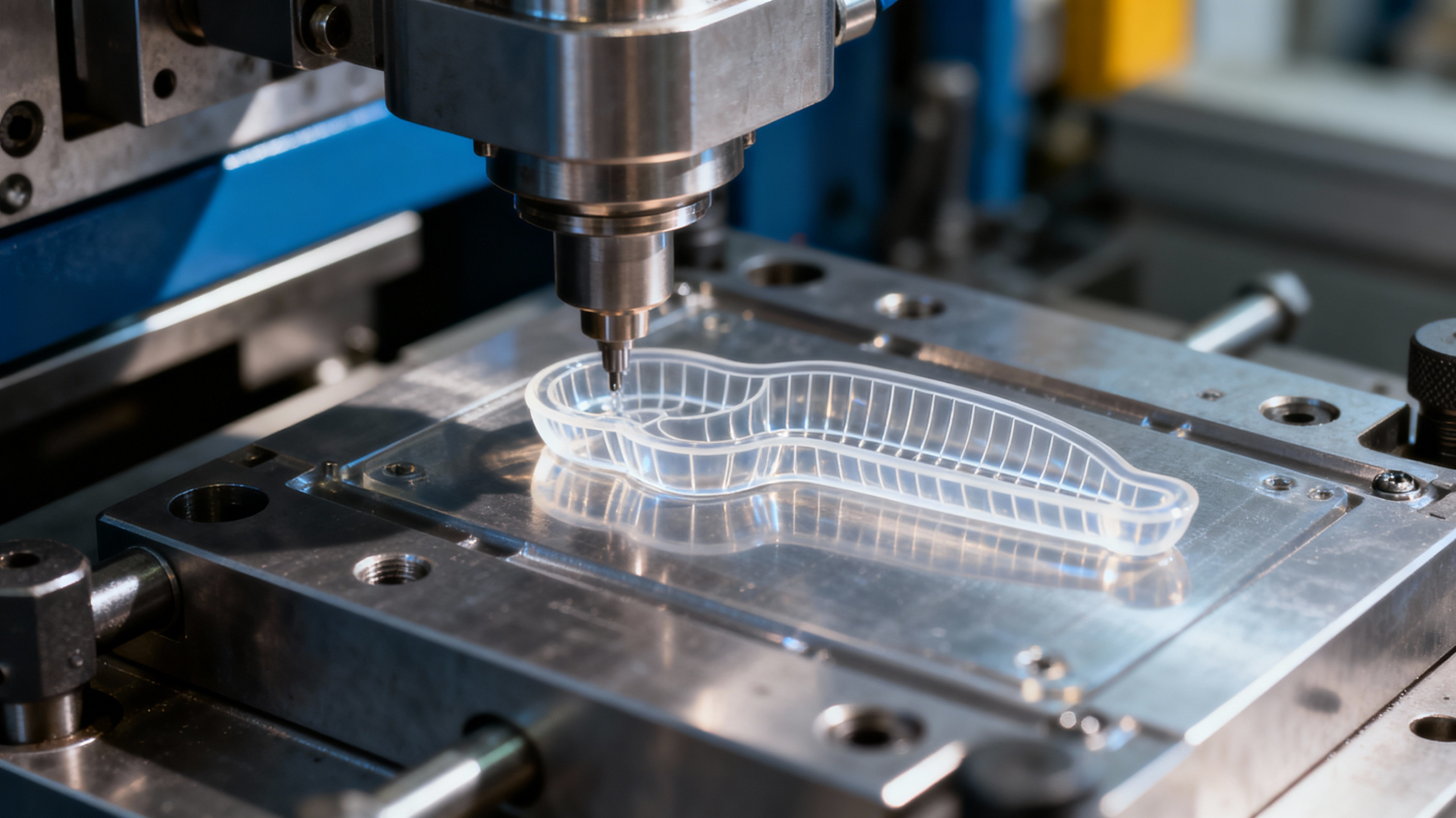
The superior capability of liquid silicone rubber injection molding to produce ultra-thin, complex geometries derives directly from the material’s low viscosity and shear-thinning behavior. Unlike High Consistency Rubber (HCR), which acts as a solid resisting flow and necessitating high packing pressure, LSR functions as a pumpable liquid. It flows effortlessly into mold cavities as thin as 0.25mm without premature curing or induced stress. This fundamental difference enables engineers to design intricate, lightweight micro-components with precision, bypassing the physical limitations and manual processing constraints inherent to solid rubber molding.
Overcoming Physical Barriers with Low Viscosity Mechanics
The fundamental advantage of LSR lies in its rheological properties, which allow it to navigate micro-channels that solid rubber cannot penetrate without excessive force. Understanding these physics helps engineers push the boundaries of component miniaturization.
Leveraging Shear-Thinning for Micro-Channel Flow
The molecular weight of LSR typically ranges between 50,000 and 100,000 g/mol, significantly lower than HCR, which often exceeds 400,000 g/mol. This structural difference results in a lower initial viscosity. Crucially, LSR exhibits non-Newtonian, shear-thinning behavior; as injection speed increases, viscosity decreases. In a liquid silicone rubber injection molding machine, this property allows the material to fill long, thin flow paths with reduced injection pressure. Conversely, HCR requires high pressure to overcome its “memory” and elastic resistance, often leading to mold deflection or incomplete filling in sections under 0.5mm. LSR fills 0.25mm sections consistently, ensuring full cavity packing without damaging delicate mold cores.
Eliminating Stress in Ultra-Thin Geometries
Molding thin walls with high-viscosity materials often introduces residual stress, leading to warping or dimensional instability post-cure. HCR processing frequently relies on compression or transfer molding, where uneven pressure distribution can deform thin cross-sections. Injection molding liquid silicone rubber utilizes a low-pressure filling phase followed by thermal curing. Because the material enters the cavity as a low-viscosity liquid, it exerts minimal hydraulic stress on the mold walls. This is vital for maintaining tight tolerances in micro-valves or diaphragms, where even micrometer-level deviation affects performance.
Automated Precision in Liquid Silicone Rubber Injection Molding
Transitioning from manual compression methods to fully automated injection processes significantly enhances repeatability and efficiency. This shift is critical for industries requiring high-volume, defect-free production of complex silicone components.
Optimizing the Liquid Silicone Rubber Injection Molding Machine
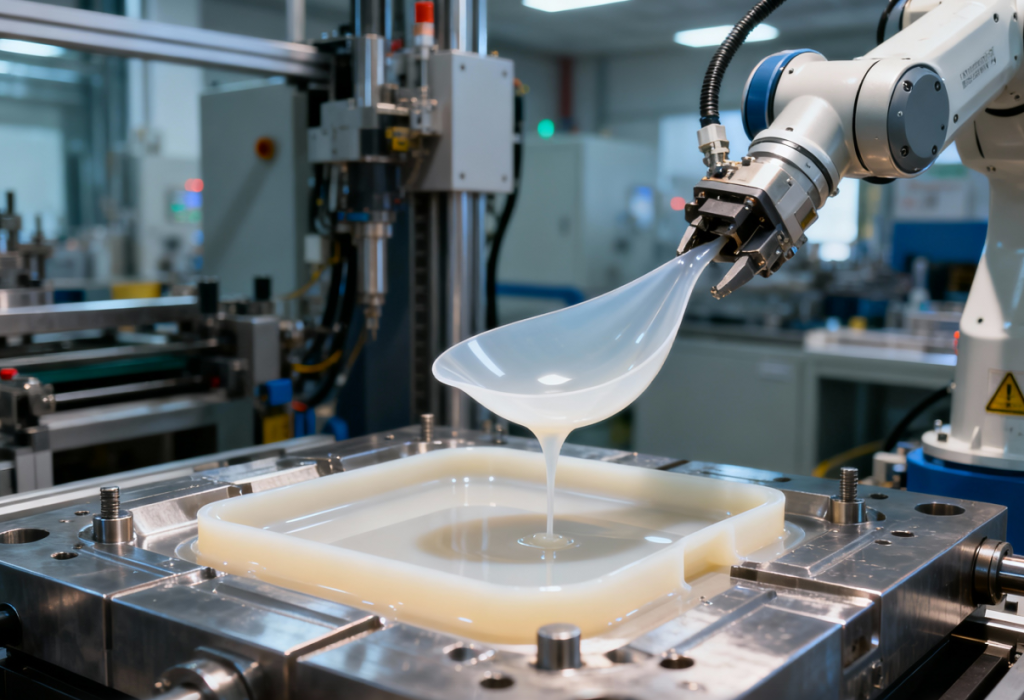
The efficiency of LSR production stems from the integration of cold deck systems and rapid curing cycles. While HCR cycle times often range from 3 to 5 minutes due to the need for heating substantial thermal mass, LSR cycles can be as short as 30 seconds to 3 minutes depending on part thickness. The machine maintains the material at a cool temperature until it reaches the heated cavity, triggering instant vulcanization. This thermal management allows rubber injection molding suppliers to achieve high throughput. Furthermore, automated demolding systems, such as robotic grippers, can safely extract delicate thin-wall parts that might tear during manual removal associated with HCR compression molds.
Closed-Loop Dosing for Zero-Defect Consistency
Achieving flashless parts requires precise control over the material volume. Custom liquid silicone rubber injection molding utilizes closed-loop metering systems that mix Part A and Part B compounds with high accuracy. This ensures homogeneity even in shot weights as small as a fraction of a gram. In contrast to the manual weighing often required for HCR pre-forms, the automated dosing unit continuously adjusts pressure and volume. This precision minimizes flash formation, reducing the need for secondary trimming operations and ensuring that complex features, such as undercuts or sealing lips, remain intact and functional.
Advanced Tooling Solutions by Livepoint Tooling
With over 23 years of expertise, Livepoint Tooling specializes in precision mold manufacturing and high-volume production, adhering to ISO 9001 and IATF 16949 standards for the automotive and medical sectors.
Precision Mold Manufacturing for Complex Geometries
Livepoint Tooling engineers molds capable of handling the low viscosity of LSR, ensuring flash-free production even at parting lines. By utilizing hardened steel inserts and vacuum venting systems, the company facilitates the evacuation of air from micro-cavities, preventing burns and short shots. Their approach to liquid silicone rubber injection molding manufacturer services involves rigorous DFM (Design for Manufacturing) analysis, optimizing gate locations to support thin-wall filling without air entrapment. This capability is essential for producing intricate components like waterproof seals for electronic control units (ECUs) and flexible medical diaphragms.
Scalable Production for Automotive and Medical Sectors
Livepoint Tooling supports clients from rapid prototyping to mass production. Their facility is equipped to handle strict requirements for cleanliness and traceability, critical for finding a reliable liquid silicone rubber injection molding company. Whether the project involves Two-Shot molding for multi-material integration or high-cavity molds for maximum output, Livepoint leverages its “Smart Production Capacity” to maintain consistency. Their adherence to IATF 16949 ensures that automotive components meet rigorous quality benchmarks, providing a robust solution for procurement directors seeking long-term supply chain stability.
Conclusion
Switching to low-viscosity LSR enables the production of superior thin-wall components that solid rubber cannot match. Upgrade your component precision by leveraging advanced flow mechanics; contact Livepoint Tooling today to review your thin-wall designs with our engineering team.